🚢 Demurrage, Detention, and Storage – What's the Difference?
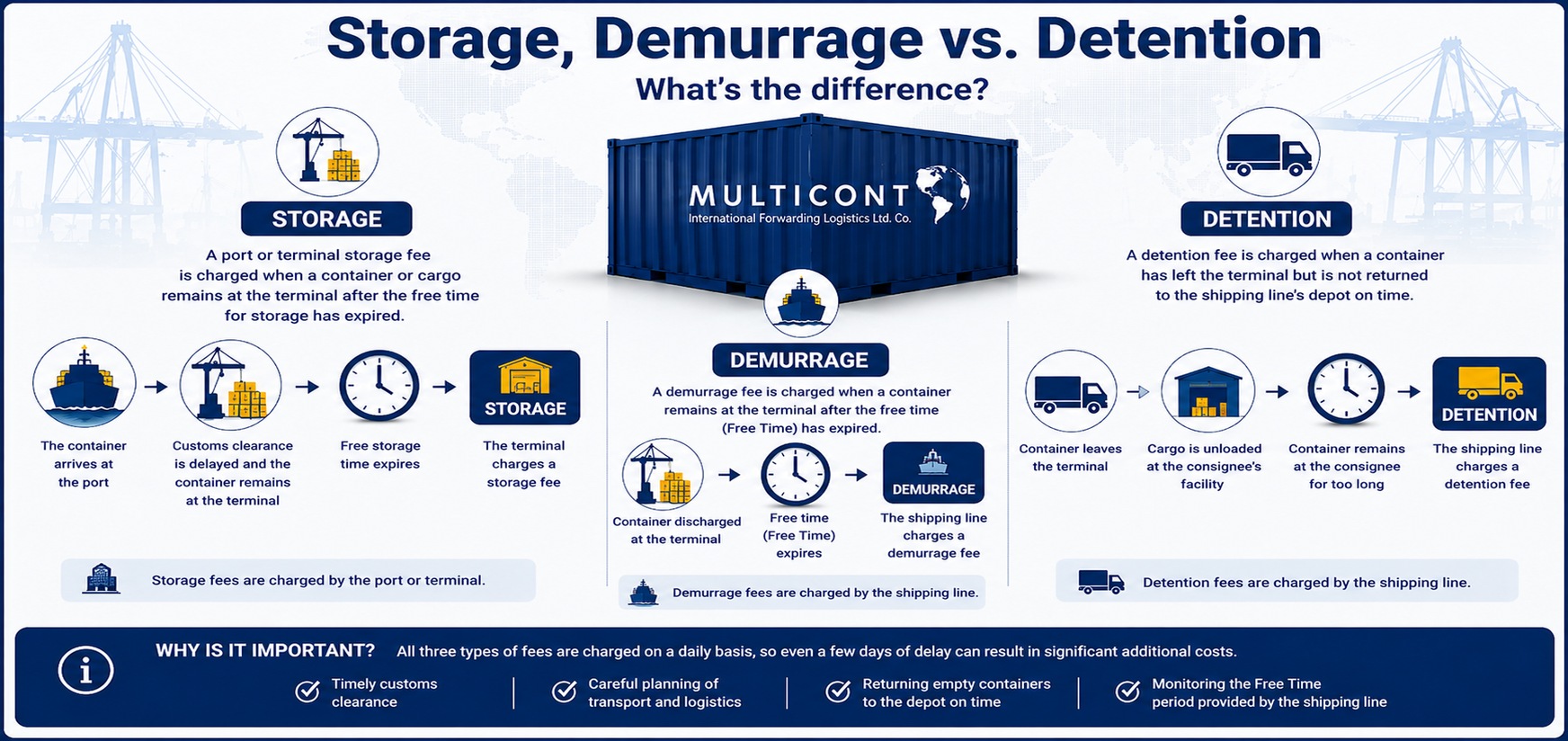
In container sea freight, we may encounter three types of costs that are often confused with one another: Demurrage, Detention, and Storage fees. Although they are often thought to be the same thing, these are actually three different types of fees that arise in different situations.
Knowing these three concepts precisely can help you avoid significant extra costs and the inconvenience caused by delays.
🚢 Storage Fee
Storage is a fee charged by the port or terminal when the container or goods remain at the terminal after the free storage period has expired.
This, then, is a fee charged by the port or terminal, not the shipping line.
For example:
- the container arrives at the port;
- customs clearance is delayed;
- the container is not picked up in time;
- the terminal charges a Storage fee.
⚓ Demurrage
The Demurrage fee is typically charged by the shipping line if the container remains at the terminal after the contractually defined free period (Free Time) has expired.
For example, in the case of imports:
- the ship arrives at the destination port;
- the container is unloaded at the terminal;
- the free period provided by the shipping line expires;
- the container remains at the terminal;
- a Demurrage fee is incurred.
In certain cases, both Storage and Demurrage fees may be charged for the same period, since they are charged by two different parties (the terminal and the shipping line).
🚛 Detention
The Detention fee arises when the container has already left the terminal but is not returned to the empty-container depot designated by the shipping line in time.
For example:
- the container leaves the terminal;
- it arrives at the consignee's premises;
- the goods are unloaded;
- the empty container is not returned in time;
- the shipping line charges a Detention fee.
Detention can occur in both import and export shipments.
⚙️ Why Does It Matter?
All three types of fees are typically charged on a daily basis, so even a delay of just a few days can result in significant extra costs.
In most cases, they can be prevented with proper preparation:
- by arranging customs clearance in time;
- through precise scheduling of transport arrangements;
- by returning empty containers by the deadline;
- by monitoring the Free Time period provided by the shipping line.