📐 Container Sizes – A Quick Overview
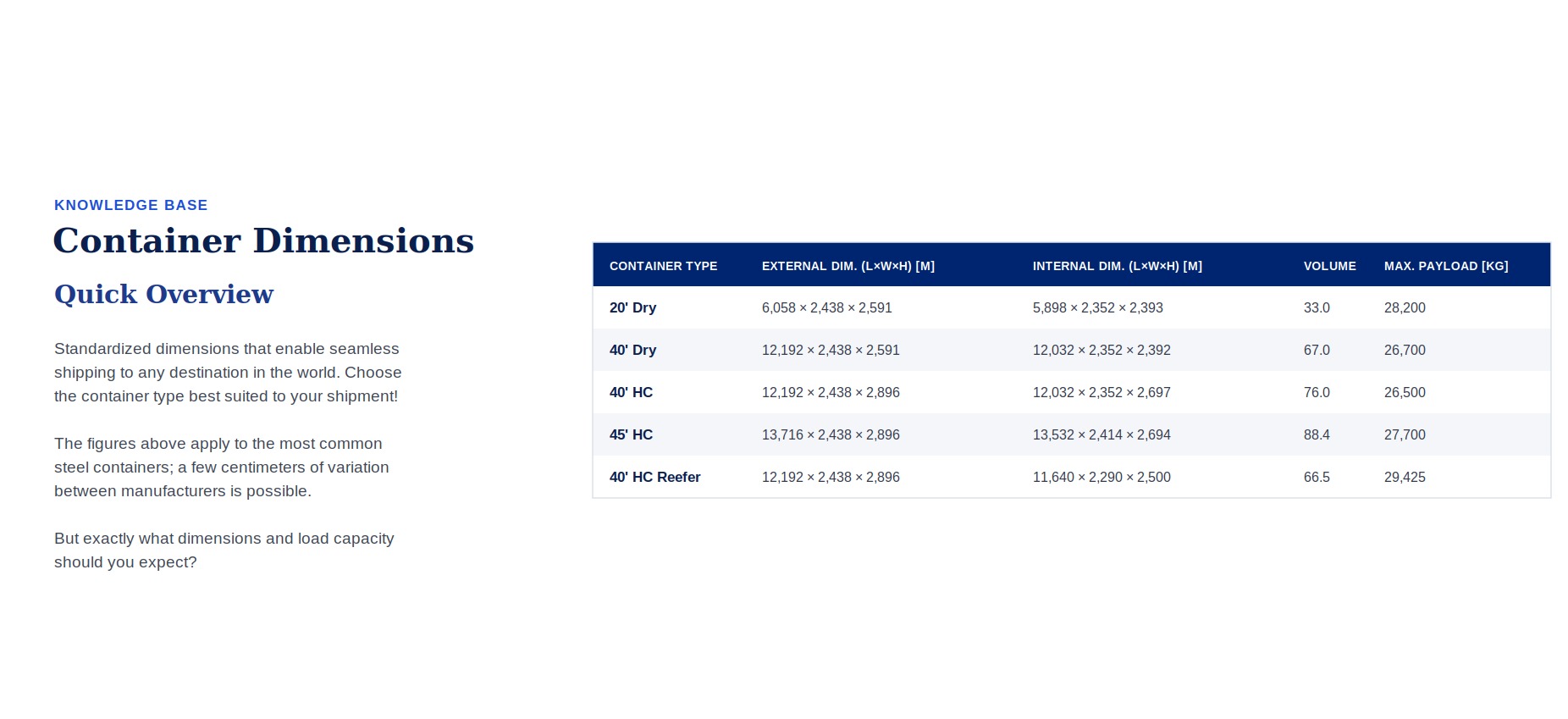
One of the cornerstones of container shipping is standardized container size — without it, seamless global transfer between ship, rail, and road wouldn't work (as we also covered in our article "The History of Container Shipping"). Standardized container dimensions (ISO 668) allow a container to be compatible with any mode of transport, anywhere in the world. Sea container dimensions are given in feet (ft) because the standards of container shipping originated in the United States and the Anglo-Saxon shipping world. These dimensions have since become an international standard and are still used this way worldwide today. Choosing the right type and size directly affects the cost-efficiency and safety of transport. But exactly what dimensions and load capacity should you expect?
📏 The Most Common Container Types – External and Internal Dimensions
| Container Type | External Dimensions (L×W×H) [m] | Internal Dimensions (L×W×H) [m] | Volume [m³] | Max. Payload [kg] |
|---|---|---|---|---|
| 20' Dry | 6.058 × 2.438 × 2.591 | 5.898 × 2.352 × 2.393 | 33.0 | 28,200 |
| 40' Dry | 12.192 × 2.438 × 2.591 | 12.032 × 2.352 × 2.392 | 67.0 | 26,700 |
| 40' HC | 12.192 × 2.438 × 2.896 | 12.032 × 2.352 × 2.697 | 76.0 | 26,500 |
| 45' HC | 13.716 × 2.438 × 2.896 | 13.532 × 2.414 × 2.694 | 88.4 | 27,700 |
| 40' HC Reefer | 12.192 × 2.438 × 2.896 | 11.640 × 2.290 × 2.500 | 66.5 | 29,425 |
The figures above apply to the most common steel containers; a few centimeters of variation between manufacturers is possible.
⚖️ Why Does This Matter?
- Load planning: knowing the maximum payload is essential to avoid overloading and the resulting fines or delays.
- Space utilization: knowing the exact internal dimensions helps plan loading optimally, avoiding unnecessary empty space.
- Vehicle and route compatibility: some routes, bridges, or tunnels have size restrictions — this must already be taken into account when planning transport.