📦 FCL vs. LCL – Which Is the Right Choice for Your Shipment?
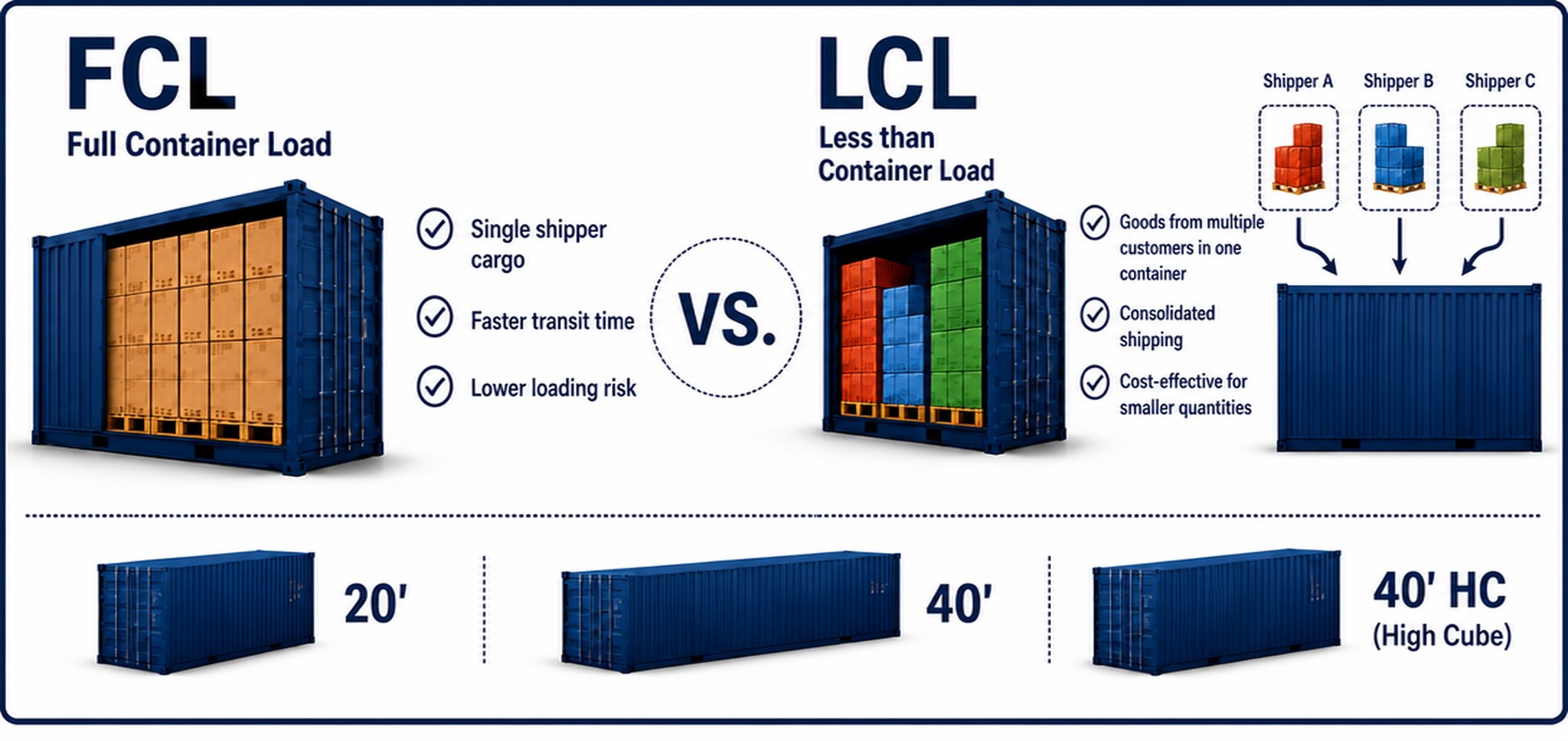
In container sea freight, almost everyone has heard the abbreviations FCL and LCL, yet many people are unsure exactly what they mean and which one to choose for a given shipment. Yet the right decision can bring significant savings in both cost and time.
📦 What Is FCL?
FCL (Full Container Load) means that an entire container is booked exclusively for transporting your goods. The container is loaded at the shipper's premises (or a warehouse), then sealed — and it remains sealed all the way to the consignee, without any intermediate unloading or transshipment.
It's important to know: FCL doesn't mean the container has to be completely full — the point is that the entire container is dedicated to your goods, even if it isn't completely filled.
📥 What Is LCL?
With LCL (Less than Container Load), i.e. consolidated freight, smaller quantities of goods from several shippers are combined into a single shared container. You only pay for the space your goods actually occupy — this is a particularly economical solution for smaller quantities.
⚖️ Which Should I Choose?
The decision depends on several factors:
- Quantity: as a general rule of thumb, above roughly 13–15 cubic meters (CBM), FCL is the more economical choice; below that, LCL tends to pay off better.
- Speed: FCL is typically faster, as there's no need for consolidation or sorting at either the origin or the destination.
- Security: with FCL, the container remains sealed for the entire journey, so the risk of damage or mix-up is lower. With LCL, the goods pass through more hands, which carries somewhat greater risk.